Russia notes Trump's dispute with NATO allies over Greenland as European troops head to Arctic for war games
Russia says geopolitical tension in the Arctic is of "the gravest concern," as European NATO members ramp up for war games in the region and Moscow seeks to highlight the disagreement between the Trump administration and its closest allies over Greenland.
"NATO has embarked on a course of accelerated militarization of the North, increasing its military presence there under the fictitious pretext of a growing threat from Moscow and Beijing," Russia's embassy in Belgium said in a statement late Wednesday.
The statement went on to say that Russia advocates for peace, cooperation and dialogue in the region, but that, "NATO members show no disposition to resolve issues in a constructive manner."
"The militaristic spirit within the alliance is only growing stronger, and given the disagreements that have emerged within the bloc over the Greenland issue, its ability to reach agreements is becoming increasingly unpredictable, including on Arctic matters," the Russian embassy said. "We consider the alliance's line of escalating confrontation in the Arctic to be counterproductive and extremely dangerous."
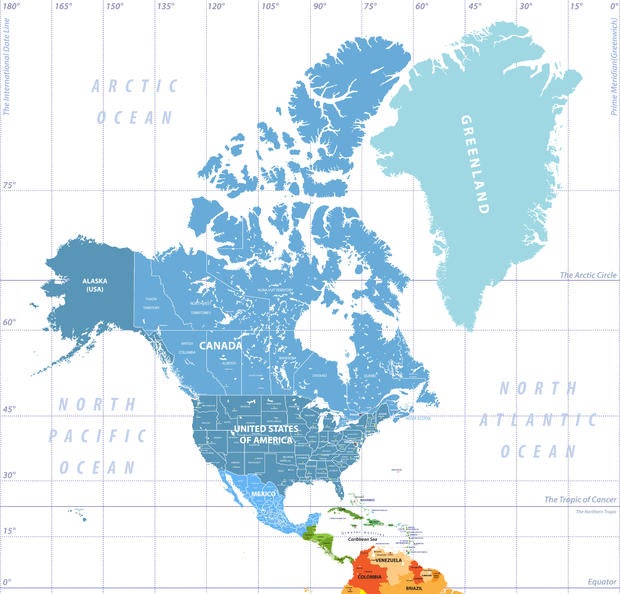
The statement came as top Trump administration officials met in Washington with Danish and Greenlandic officials to discuss Mr. Trump's repeated vows to make the vast, largely frozen island part of the United States. The White House says the U.S. needs control of the resource-rich island, long a semi-autonomous territory of Denmark, for security reasons, claiming that Russia and China will otherwise take it over.
America's European allies, and Greenland's own government, have vehemently rejected the notion of the U.S. taking control of the island, by any means, and argued that U.S. ownership is unnecessary for security reasons, as Greenland is already NATO territory.
After the meeting, Denmark's foreign minister said his country and the U.S. still had "fundamental" differences over Greenland's future, but would continue to talk.
EU leaders, meanwhile, have also sought to acknowledge Mr. Trump's concerns about rising security threats around Greenland.
"Geopolitical tensions have spread to the Arctic," Denmark's defense ministry said in a statement on Wednesday. "The Government of Greenland, and the Danish Ministry of Defence have therefore decided to continue the Danish Armed Forces' increased exercise activity in Greenland, in close cooperation with NATO allies."
"The purpose is to train the ability to operate under the unique Arctic conditions and to strengthen the alliance's footprint in the Arctic, benefiting both European and transatlantic security," the ministry said.
"Don't listen to Russian propaganda," Lars-Christian Brask, vice-chair of the Danish Parliament's Foreign Policy Committee, told CBS News on Thursday, calling the meeting in Washington between U.S., European and Greenlandic officials positive despite the lack of a resolution to the matter.
"I think it's positive that the clear disagreement that is there between Denmark, Greenland and the U.S. will be taken into a platform, a high level working group," Brask said, calling it "a good way of continuing finding out what we can do to solve this situation."
"It's all about talking. It's about communicating. It's trying to solve an issue that wasn't solvable in an hour's meeting yesterday," Brask said.
Aaja Chemnitz, a Greenlandic member of Denmark's Parliament, told CBS News on Thursday, "Many of us were concerned that it would be the same as Zelenskyy when he was in the White House, and therefore, taking into account the whole situation, I think it was a success."
"What I hear from back home [in Greenland], which I think is very important to also emphasize, is that children are concerned. They're talking about their concerns at school. We have elders that are not sleeping because they are concerned. I think all of this that has happened has been offensive towards us. I think some of it has been appalling. And therefore, it's important to take out the intensity. And a little bit has been taken out from the meeting yesterday, but this is a marathon and not a short sprint, and we need to make sure that Greenland and Denmark stay as close an ally in this situation," Chemnitz said.
Mr. Trump has disparaged efforts by Denmark to increase security for Greenland, saying Wednesday in a post on social media: "Two dogsleds won't do it! Only the USA can!!!"
Denmark says it's invested almost $14 billion in Arctic security, and ahead of the military drills in the region, its European partners also signaled their investment in the island's defense.
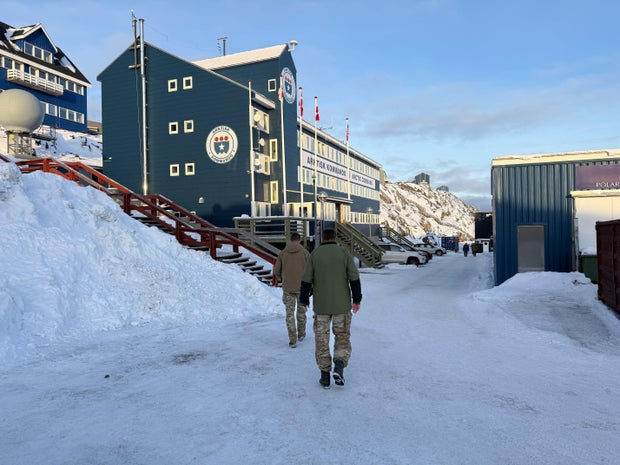
A small number of European troops were arriving in Greenland Thursday to participate in the upcoming exercise. Germany said it was sending 13 troops to Greenland's capital Nuuk. The Netherlands said it would be working with NATO to conduct joint reconnaissance ahead of the military exercise, and sending one officer from its navy, and Finland said it would be sending two liaison officers.
A small group of French troops had arrived in Greenland as well, French President Emmanuel Macron said.
Addressing military personnel in Istres, France, on Thursday, Macron said, "history forgives neither lack of preparation nor weakness."
"Europeans have a particular responsibility, as this territory [Greenland] belongs to the European Union … An initial military team is already on the ground and will be reinforced in the coming days with land, air, and sea assets," Macron said.
Macron said France must play the role of "being available in the face of the threat, to know how to adapt itself, and to be on the side of a sovereign country to protect its territory."