Employers added 64,000 jobs in November, but unemployment rate jumps to highest in 4 years
Employers across the U.S. added 64,000 jobs in November, beating economists' forecasts, new government data shows, even as new October figures revealed a loss of 105,000 jobs, a sign the labor market remains under pressure.
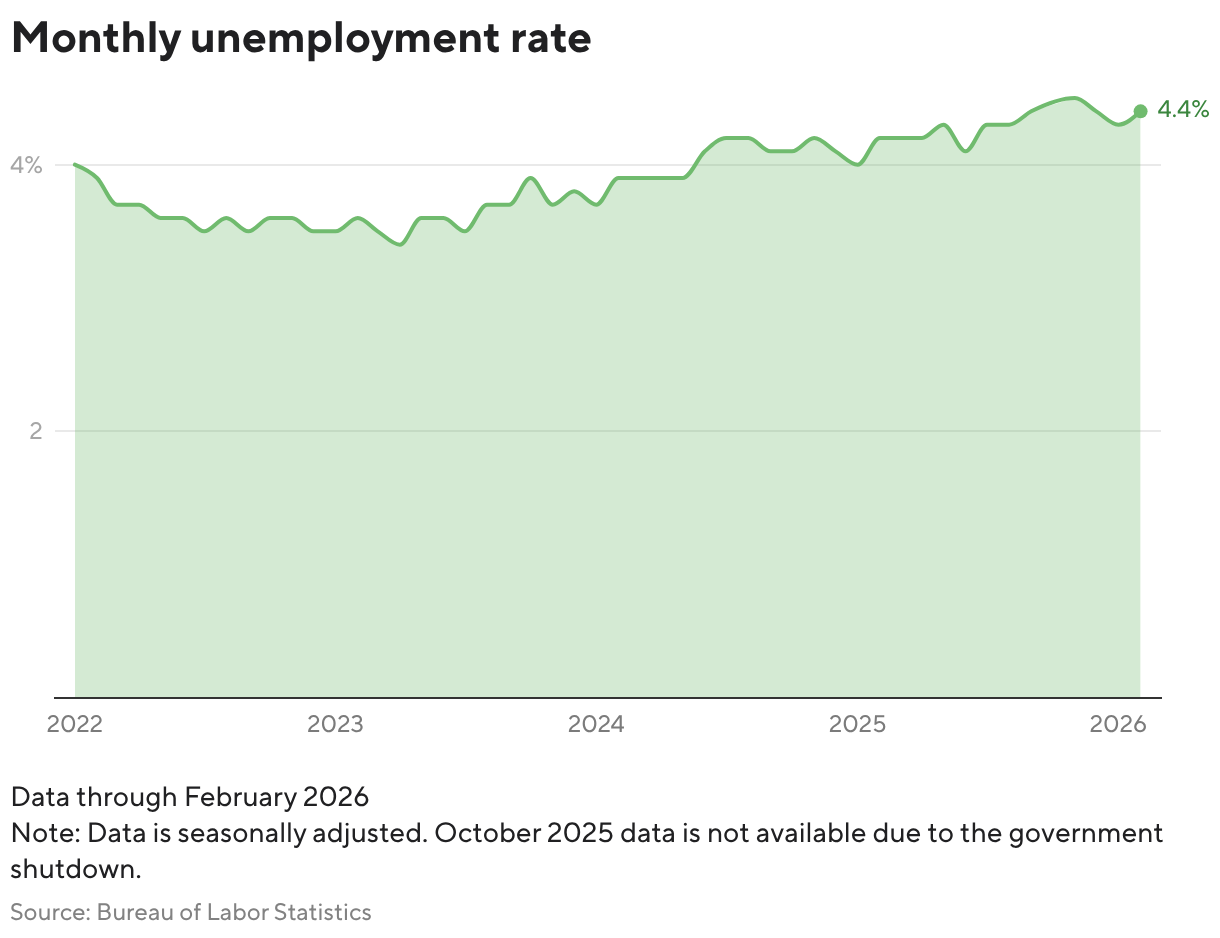
The unemployment rate in November rose to 4.6%, the highest level since September 2021.
The November employment report offers a fresh picture of the labor market after a six-week blackout in official data caused by the recent government shutdown. The data suggests that employers in industries ranging from manufacturing to hospitality are hitting the pause button on hiring amid concerns about economic growth and tariff costs, some economists noted.
"Businesses are not hiring as they adjust to tariffs, uncertain conditions and AI. The result is about 700,000 more unemployed Americans than there were a year ago," said Heather Long, chief economist at Navy Federal Credit Union, in an email.
By the numbers
Economists had forecast payroll gains of 40,000 jobs in November, according to a poll by FactSet.
The Labor Department on Tuesday also released partial employment data from October, which shows a loss of 105,000 jobs that month.
The drag on October employment was driven by a steep loss in the federal workforce, which shed 162,000 jobs that month. The decline is due to a wave of deferred resignations starting to show up in the payroll data, according to Samuel Tombs, chief U.S. economist at Pantheon Macroeconomics.
Job growth for August and September was also revised down by a collective 33,000.
The government's official employment data for October and November had been delayed due to the 43-day government shutdown, which ended in last month.
In the absence of federal data, economists at the Federal Reserve and on Wall Street had been monitoring alternative sources, which have signaled ongoing headwinds in the labor market. For instance, ADP earlier this month said private-sector employers in the U.S. cut 32,000 jobs in November, while outplacement firm Challenger, Gray & Christmas has tracked more than 1.1 million layoffs so far this year.
Economic uncertainty has led workers to stay put and employers to pull back on hiring, creating a difficult situation for job seekers, especially those early in their careers.
The labor market is slowly cooling, Federal Reserve Bank of New York president John C. Williams said in a speech Monday.
"I should emphasize that this has been an ongoing, gradual process, without signs of a sharp rise in layoffs or other indications of rapid deterioration," Williams said. But, he added, "Job growth has been anemic."
What it means
The unemployment rate ticked up to 4.6% in November — the highest since September 2021 — as more people entered the labor force to look for jobs, according to Adam Crisafulli, head of Vital Knowledge.
While the numbers offer a glimpse into the labor market during the government shutdown, experts say investors and government officials will likely view the data with some skepticism, given questions about the accuracy and completeness of data collection following the shutdown.
Indeed, the Federal Reserve may not place much emphasis on the November numbers at its January rate-setting meeting because of the data disruption, said Kay Haigh, global co-head of fixed income and liquidity solutions at Goldman Sachs Asset Management.
"The report on December's employment data, released in early January ahead of the next meeting, will likely be a much more meaningful indicator for the Fed when it comes to deciding the near-term policy trajectory," he said in an email.
Earlier this month, Federal Reserve Chair Jerome Powell said the central bank would likely view the October and November data with a "somewhat skeptical eye," given the data may be distorted.
The larger-than-expected rise in the unemployment rate could, however, raise concerns within the Fed, said Seema Shah, chief global strategist of Principal Asset Management, in an email.
The central bank lowered interest rates by 0.25 percentage points for the third consecutive time last week, citing the rise in the downside risks to employment.