There were suspicions, but nobody knew for sure whose side Eddie Villarreal was on until the night he pulled over the two FBI agents.
By day, Villarreal was a Dallas Police officer. By night, he had a different job — moonlighting as a security guard for Alfredo Hinojosa, a nightclub mogul who federal authorities suspected was involved in a cartel-connected drug ring.
Inside the restroom stalls of three of Hinojosa’s clubs, dealers sold hundreds of small bags of cocaine every weekend, according to federal court records. Agents suspected Villarreal was protecting the owner’s enterprise. To test him, they tailed one of the club’s leaders to see if he interfered.
When the blue and red lights of Villarreal’s black Chevy Tahoe flashed behind them, they had their answer. The moonlighting officer had chosen his other boss.
After being pulled over, the FBI agents fed Villarreal a few false details about their investigation.
Soon after, Villarreal called Hinojosa to relay what he had learned — unaware that the FBI was listening on a wiretap.
"You know there’s drugs in the bathroom. I know there’s drugs in the bathroom," the police officer told the club owner.
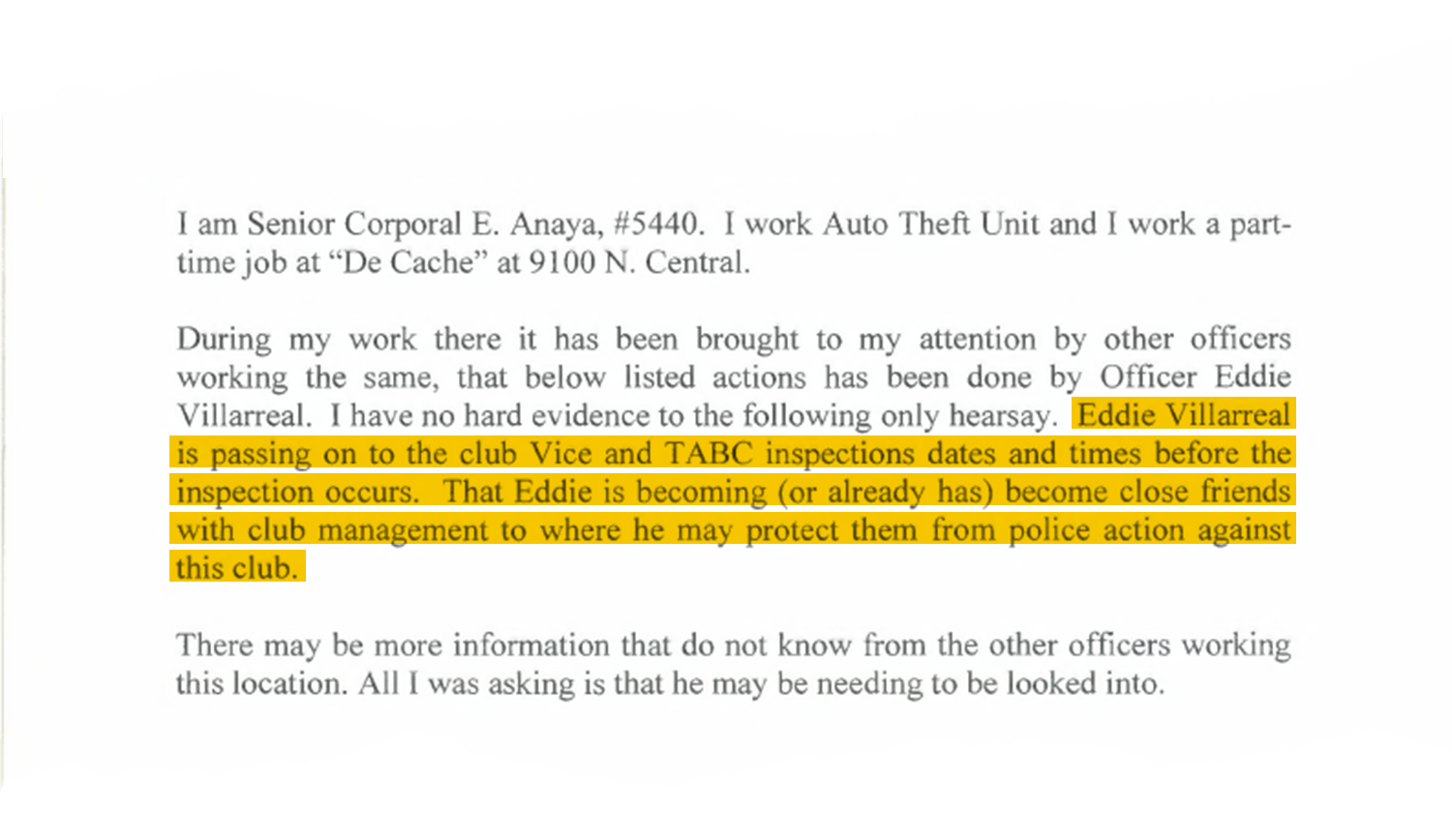
In the years leading up to Villarreal’s nighttime stop, Dallas Police heard multiple warning signs about the officer’s off-duty behavior. Investigators found that he routinely broke one of the department’s moonlighting rules by working inside the club instead of the parking lot. Two patrons accused him of brutal assaults. And in 2002, a fellow officer worried that he might alert a different club owner before police vice raids.
Despite the repeated warnings, the department continued allowing him to moonlight.
Villarreal and his lawyers did not respond to repeated requests for comment from CBS News.
Villarreal’s case exposes the potential oversight gaps and ethical hazards when police officers work off-duty security jobs. Moonlighting has long offered police officers a financial lifeline — extra income to help their families. But in some departments, the failure to adopt strong oversight rules for lucrative private side jobs can leave officers and the public vulnerable to corruption and danger. Loyalties may be tested in ways not seen on regular duty.
An investigation by CBS News and the Howard Center for Investigative Journalism at Arizona State University found many U.S. police agencies rely on moonlighting rules that are vague, poorly enforced and vulnerable to abuse.
The investigation examined off-duty employment policies at more than 100 law enforcement agencies of various sizes across the country, finding that less than a quarter check officers’ disciplinary history before permitting them to moonlight. More than half don’t require body cameras for off-duty work and most fail to track officers’ off-duty hours.
Five departments, including Boston Police, permit officers suspended for misconduct to continue working off-duty — performing police-like duties for private businesses even while barred from regular shifts. That contradicts best practices recommended by the International Association of Chiefs of Police, which suggest restricting off-duty work to officers who "are not the subject of ongoing disciplinary action that would be considered serious or egregious."
Some departments, including the San Diego County Sheriff’s Office and the Michigan State Police, ban off-duty security work.
See our analysis of moonlighting policies at departments across the country here.
In Dallas, records show leaders largely failed to act after two city audits cited their lax oversight of off-duty employment — and warned of consequences.
Instead, a CBS News review of agency records shows Dallas Police loosened moonlighting rules and let more than 800 officers with red flags — criminal investigations, violations of the department’s off-duty policy and alerts from the agency’s early warning system — keep working off-duty jobs since 2010.
Dallas Police Department leadership declined to comment on the findings of this story.
The leader of the city's largest police union, Jaime Castro, acknowledged the department previously struggled tracking officers’ moonlighting work, but said recent policy changes — including a new app to track the extra jobs — could help curb some of the problems.
Castro argued off-duty work boosts public safety and the extra cash incentivizes recruits to join the police force — and stay. News reports document moonlighting officers across the country earning between $45 to $175 an hour, far outpacing the median pay for officers, which was about $37.15 an hour in 2024.
"Once officers join the department they see the benefit. They see the freedom that it gives you and that sense of financial security it gives you," said Castro, a 27-year Dallas Police veteran. "It’s a retention tool."
But without proper oversight, experts and police groups warn off-duty work can enable abuse and erode public safety.
"If you do not track what your employees are doing, and if you do not supervise them as they do it, and if you do not provide that level of approval and administrative oversight, then what are you doing?" asked Seth Stoughton, a former Tallahassee, Fla., police officer who is now faculty director of the Excellence in Policing & Public Safety program at the University of South Carolina.
"You're setting the stage for officers to sink to the lowest common denominator."
Missed warnings
To examine the oversight gap in one city, CBS News reviewed Dallas Police documents and data spanning decades.
The department’s policy has long stated that off-duty work is a "privilege, not a right." Until recently, supervisors were required to consider whether officers had a "high frequency level of complaints" before approving off-duty jobs.
Despite these rules, officers with disciplinary problems routinely got approval. Since 2011, nearly 400 Dallas officers investigated for crimes — including assault, theft, and sexual misconduct — were allowed to continue to moonlight. In at least 59 cases, officers were allowed to work off-duty jobs within a day of the start of their criminal investigations.
The department also approved side jobs for at least 396 officers even after alerts from its own early-warning system identified them as a potential threat to themselves or others.
"If you’re wearing your uniform performing a role as a police officer and the department has knowledge that you could be problematic, then the department is — or at least should be — liable for the outcome of whatever occurs," said Dennis Kenney, a professor at the John Jay College of Criminal Justice.
In 2005, city auditors found Dallas Police’s oversight of moonlighting "not effective," recommending stronger monitoring and charging businesses fees to recover costs. The department did not adopt most of their recommendations.
Thirteen years later, in 2018, auditors again found lax oversight and uncovered nearly 3,200 cases of officers moonlighting while on paid sick leave.
In 2023, auditors reported the department still hadn’t implemented many of the tracking reforms. Only last year did Dallas Police introduce a tool to prevent officers from working off-duty jobs while on sick or injury leave.
Few officers illustrate the breakdowns in Dallas more than Ray Cunningham.
Since 1987, Dallas Police records show that Cunningham has been accused of violating police policy at least 68 times, including 15 times for excessive force and five for breaking moonlighting rules.
In 1996, an anonymous complainant wrote a letter to Dallas Police alleging that Cunningham was double billing for the same hours at three different apartment complexes. Police investigators found that "sufficient evidence exists" to suggest that Cunningham had committed felony theft, but a grand jury did not indict him, according to the agency’s disciplinary records.
Throughout the 1990s and 2000s, multiple apartment complex residents alleged that Cunningham harassed and assaulted them — including one incident where the officer beat a handcuffed man and put him into a sleeper hold.
In 2017, city records show the department’s early warning system alerted supervisors that Cunningham had racked up five misconduct complaints in 12 months, indicating "the officer’s performance may need to be reviewed."
Asked about his disciplinary history by CBS News, Cunningham wrote only, "No comment."
Stoughton, the policing scholar, said Cunningham’s history opens the department up to potential legal liability.
"I don't know how you look at that — at that officer, at that pattern — and justify not doing anything," he said.
On May 28, 2021, investigators issued Cunningham a 10-day suspension after he failed to seek permission to work an off-duty job at an apartment complex 83 times in nine months.
The following night, records show the department allowed him to work off duty at the same apartments.
Accountability gaps nationwide
Dallas is not unique. In dozens of departments, reporters found accountability measures for officers working off duty are looser than when they’re on duty.
One example: body cameras.
Most agencies require cameras on duty, yet only 43% of the departments studied by CBS News and the Howard Center mandate them for moonlighting officers. Some agencies, including Chicago Police and the Cook County Sheriff’s Office, ban them outright.
In some cities, moves to require cameras on off-duty jobs met resistance. After a federal attempt to mandate them in Cleveland, police asked a judge to make wearing body cameras on off-duty jobs optional. The reason: the police union opposed them. Cleveland still does not require cameras for its moonlighting officers.
After an off-duty Baltimore County officer shot a shoplifting suspect in 2018, Maryland lawmakers proposed mandatory body cameras for moonlighting. But the bill failed.
County police spokesperson Trae Corbin said the department believes cameras violate state wiretapping law. But nearby departments, including Baltimore City police, allow or require them for off-duty work.
Unregulated payments for moonlighting also can create problems.
In 2017, Dallas Police Officer Raphyael Tyson began coordinating fellow officers to work at a construction site. No one suspected anything wrong with the job until three years later.
The company intended to pay the officers $75 an hour for their security services. But Tyson had only been passing $45 an hour to the other officers.
Agency investigators said the difference totaled tens of thousands of dollars.
The department fired Tyson, but he told CBS News he broke no laws, only department rules about completing a few timecards, and he considered the arrangement his private business.
"I’m not in any obligation to also tell them what I make as a contractor," he said.
Dallas, like many departments, allows officers to coordinate off-duty jobs with minimal oversight. The department does not track pay rates or payments. It even permits coordinators to distribute cash directly to other officers.
In Minneapolis, a 2023 Justice Department review found supervisors may avoid disciplining subordinates when they controlled lucrative off-duty jobs. That same year, Derek Chauvin —the Minneapolis officer convicted of the 2020 murder of George Floyd — pleaded guilty to felony tax evasion for failing to report nearly $96,000 in cash earned from moonlighting and coordinating off-duty gigs.
Many departments fail to track how much officers earn or how many hours they work off duty, according to the CBS News and Howard Center policy review.
Most agencies claim to cap off-duty hours to prevent fatigue, but only 50 out of more than 100 departments track those hours. Decades of research confirm excessive off-duty work contributes to fatigue and poor decision-making, threatening public safety.
In Texas, El Paso Police policy caps hours worked off duty each week at 25 hours. But reporters analyzed off-duty payroll data and found more than 250 officers exceeded that cap at least once between 2021 and 2024.
Auditors in Dallas, San Jose, Miami and Minneapolis found officers routinely worked beyond permitted limits — problems missed due to lack of tracking.
Failures in oversight have led to serious abuse. Jersey City suspended its off-duty program for two years after discovering officers were paid for off-duty jobs while they were supposed to be on duty. In New Orleans, investigators from the U.S. Department of Justice found officers skipped on-duty shifts for off-duty jobs. And Philadelphia Inquirer reporters uncovered city officers on sick leave working strenuous second jobs.
Not every city takes a hands-off approach. Some, like San Francisco, have adopted systems endorsed by the Commission on Accreditation for Law Enforcement Agencies, where businesses pay the department, the city keeps a processing fee and then pays the officers — often at overtime rates.
In Delaware, the Newark Police ban direct payment from private employers to officers.
"Who are you working for in that capacity at that time?" Lieutenant Gregory D'Elia asked. "Are you working for the police department if you're fully in uniform? Or are you working for the bar?"
Former Dallas Police Chief Renee Hall, now vice president of the National Organization of Black Law Enforcement Executives, insists tracking off-duty assignments is essential for accountability. Technology, such as a new early-warning system Hall tried to implement in Dallas, makes that possible.
"We need to know who an officer is working for, what establishment that is, what kind of work, and what kind of income that they're bringing in," she said.
Divided loyalties
It took a yearslong investigation — dubbed "Operation Closing Time" — to expose Villarreal’s corruption in Dallas despite the years of unheeded warning signs.
P.J. Meitl, the assistant U.S. Attorney who led the prosecutions, told CBS News that it takes strong oversight to deter lawless behavior from officers working off-duty jobs.
"If the DOJ doesn’t pursue cases like the one against Villarreal, he would have continued and his corruption would have continued to spread," Meitl said.
After he pulled over the FBI agents, prosecutors confronted Villarreal and offered him a deal — resign and cooperate or face more serious charges.
But even after leaving the department and facing the possibility of years in prison, prosecutors presented evidence that he continued to help bar owners. An FBI agent testified at his sentencing hearing that agents were forced to abort an undercover operation at a bar after they were spotted by Villarreal.
Hinojosa was convicted in 2021 and sentenced to 16 years. A year later, Villarreal got 30 months in prison — six times higher than sentencing guidelines.
"If you allow law enforcement officers at any level to break the law and not have consequences," Sam Lindsay, the federal judge who heard his case, told CBS News, "then that only breeds contempt and disrespect for the law."
About the data
CBS News investigative data journalist Ari Sen obtained and analyzed five datasets from the Dallas Police Department to produce the numbers in this story:
- Internal Affairs data (1977–2024), showing officers accused of misconduct and case outcomes. "More than 800 officers with red flags" reflects only substantiated off-duty policy violations, filtered to cases received on or after Jan. 1, 2010.
- Public Integrity Unit data (2010–2024), showing officers investigated for criminal conduct.
- Early Warning System data (May 2011–Sep 2021), identifying potentially problematic officers.
- Off-duty employment data (2009–2024, excluding 2014–2015).
- Rosters of current and former Dallas Police officers, including demographics, hire date, and separation date when applicable.
The numbers in this story likely miss some instances of misconduct. All case records that could not be clearly linked to a unique badge number were excluded from the analysis and the department did not always supply complete records in response to CBS News’ records requests.
Journalists with the Howard Center for Investigative Journalism and CBS News obtained moonlighting and related policies from more than 100 police departments and worked to compare the policies against recommended best practices. For more details on the process of analyzing these policies, please refer to the methodology in Part 2.
Credits
Reporting by Ari Sen, Brian New and Lexi Salazar for CBS News and Tallulah Anne, Chad Bradley, Kaylin Cantu, Emma Croteau, Sam Ellefson, Aspen Ford, Naomi Jordan, Tag Lee, Christopher Lomahquahu, Nicole Macias Garibay, Isabelle Marceles, Shayla McKenzie, Anna Olp, Madison Perales, Eshaan Sarup for the Howard Center for Investigative Journalism. Data analysis by Ari Sen for CBS News and Tallulah Anne and Emma Croteau for the Howard Center. Field production by Laura Geller, Nicole Vap and Donald Leonard for CBS News and Tallulah Anne, Chad Bradley and Aspen Ford for the Howard Center. Graphics, design and development by Taylor Johnston for CBS News. Photojournalism by Mike Lozano and Jose Sanchez for CBS News. Video editing by Scott Fralicks of CBS News. Editing and project leadership by John Kelly, Scott Pham, Matt Mosk, Laura Geller and Nicole Vap for CBS News and Mark Greenblatt, Lauren Mucciolo and Angela M. Hill for the Howard Center.