Hoops dilemma solved by physics whiz?
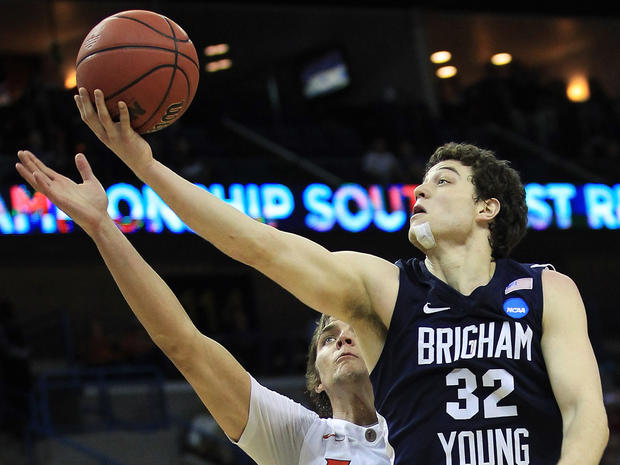
When is the right time for a basketball player to go to the rim or pull up for a jump shot? Rhetorical question, obviously, since every hoops player worth their salt knows the right answer is: It depends on the circumstance.
But now a grad student in theoretical physics says that leaving the decision up to circumstance isn't really an optimum - or even satisfying - answer. In a paper published on arXiv.org, Brian Skinner of the University of Minnesota puts forth a mathematical analysis that he says offers a better answer to a question that's been raised a million and one times, everywhere from concrete playgrounds to big city sports arenas. Specifically, says Skinner, the solution depends upon three factors:
- The (perceived) probability that the shot will go in
- The distribution of shot quality that the offense is likely to generate in the future
- The number of shot opportunities that the offense will have before it is forced to surrender the ball to the opposing team (say, because of an expired shot clock).
In this paper I address the simplest model that accounts for all three of these factors, and show that the answer to the question "when should the team shoot?" has a surprisingly intricate mathematical form.
Skinner constructed a model of the "shoot or pass up the shot" decision and then solved for what he describes as "the optimal probability of shooting at each shot opportunity." One conclusion - and one echoed by coaches from coast to coast: When there's time on the clock, don't rush and take dumb (low-quality) shots. But he also comes up with this less-obvious observation:
"Imagine, for example, two teams, A and B, that both turn the ball over every 40 seconds of possession and both have shot distributions characterized by f2 = 1, f1 = 0 (any given shot opportunity has an average quality of 0.5 points). Suppose, however, that team A has much faster ball movement, so that team A arrives at a shot opportunity every 5 seconds while team B arrives at a shot opportunity only every 10 seconds. One might expect, then, that team A should have a shooting rate that is twice as large as that of team B."
That wasn't the case. Instead, Skinner said that team B should shoot on average every 20 seconds and the twice-faster team A should shoot every 13 seconds. The net result: Team A scores 0.61 points per possession while team B scores 0.5 points per possession.
"In other words, team A's twice-faster playing style buys them not a twice- higher shooting rate, but rather an improved ability to be selective about which shots they take," he concluded.
At least that's the theory. Making it work in practice is something given to less lapidary precision.