The next step in bionics
Step by step, bionic engineers are transforming lives in ways that barely could have been imagined until recently. Our Cover Story is reported now by Barry Petersen:
A wheelchair used to be all science could offer a person stricken by paralysis. But times have changed.
It happened to Amanda Boxtel 19 years ago ... a freak skiing accident on the Aspen slopes that paralyzed her from the waist down. In time she adjusted, even to the point of skiing again ... and visiting the mountain trails near her Aspen home that she once hiked.
But life ahead is no longer about being in a wheelchair. Her determination has a new focus.
"Are you planning on dancing?" Petersen asked.
"Why not?" she replied. "It's one of my dreams, to be able to slow dance again, heart to heart. Why not? This technology is at the beginning phases of its development."
That dream starts with strapping on a device called eLegs ... an exo-skeleton with 45 pounds of batteries, a computer, sensors in the braces and in the crutches.
Standing is just the first step. Boxtel is discovering what it's like to walk again.
"Well, I just feel like it's cool to be part human and part robot. I mean, I'm the coolest girl in the world!" she laughed. "I'm the bionic woman, come on!"
"Does it feel heavy? Does it feel light? Do you feel like you're wobbly? Or what's the physical sensation?" asked Petersen.
"The physical sensation is that I don't feel weight on me. I'm on my own two feet. I don't even feel the weight of the backpack, because it's dispersed down into the ground and into the feet. I just feel like I've got this nice encasing that's going to help me along my way, and we walk together."
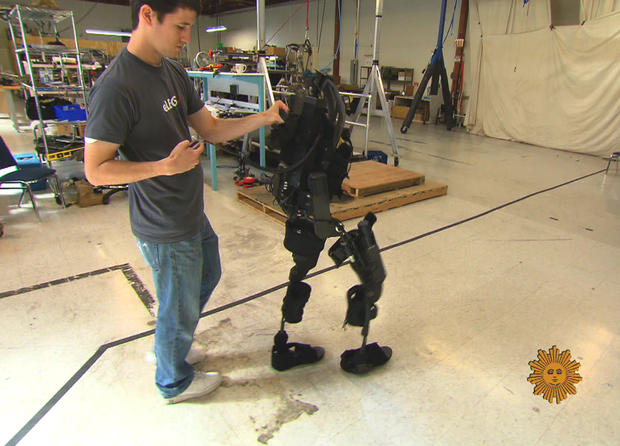
eLegs is the creation of Berkeley Bionics.
"This particular exo-skeleton includes a number of sensors that participate in the decision to instantiate a stride, to take a step," said John Fogelin, vice president of engineering.
"Part of that is in the crutches that we utilize. Those crutches have sensors within them to determine their location and their angle and force that's being placed on them. We also have sensors within the feet of eLegs. There's also sensors in each of the joints."
Bionics has been around for quite a while in the movies, like the "power loader" from "Aliens" back in 1986.
But much of the technology in Amanda's eLegs is based on an exo-skeleton under development for the military. It allows a soldier to carry up to 200 pounds, with the mechanical skeleton doing most of the heavy lifting.
"Where the ability of man stops currently, the ability of machines can pick up," said Dr. Akshat Shah, who helped develop the eLegs. His rehabilitation facility may be among the first to get working models when they become available early next year.
"While we keep looking for a cure, while we keep looking at stem cells and seeing where that process is going to lead by, we don't have to now wait 15 years while people sit idly by in their chairs," said Dr. Shah. "We can say in the meantime, 'We'll get you up, we'll get you walking. Your bones will be strong, your muscles will be healed. And when that day comes when we have a cure, you're ready."
The new world of high-tech prosthetics includes the Tibion Bionic limb, that helps stroke victims re-learn how to use their legs. It teaches a damaged brain that the leg it thinks is paralyzed can still move.
"And over repetition, it actually starts making you believe, in effect, I can do this,'" said Matt Murphy, vice president of engineering at Tibion Corporation.
"The whole intent is that after you've had your rehabilitation with the bionic leg on your leg, you would then, after the session, go home and begin putting more weight on that leg, that you actually have more confidence. It's like, 'Okay, I'm going to try a little bit more. I'm going to be a little bit more daring with this leg.' And over time, they actually get confidence back, that in fact, the leg is okay. They just have to use it more."
Clinical trials are beginning for a retinal implant - hardwired into the brain - that holds the promise of giving sight to the blind, enabling them to distinguish shapes, letters, items on a table, and maybe, with practice, faces of loved ones.
But the science of prosthetics is, increasingly, not just about improving the body as we know it, but bypassing OUR BODIES altogether - and connecting our brains to computers.
Dr. Anthony Ritaccio at Albany Medical Center in New York is developing a way to READ what is in the minds of epilepsy patients. It's called "synthetic telepathy."
"Language is just a motor task," said Dr. Ritaccio. "You're making a plan to intend to use muscles of articulation - your lips, your palate, your tongue. And that plan can be decoded. And if we can predict what word you're planning to say, you can intend it without speaking it.
"I think that's what we've been calling synthetic telepathy: the ability to communicate without formal language."
In experiments, Dr. Ritaccio and his colleagues have implanted sensors onto the surface of the brain. The sensors pick up on the patient's thoughts - which are electronically transmitted through a computer to manipulate a 3-D model of a hand, or even play video games.
Researchers at Dartmouth College have already used similar technology to make calls with an iPhone by just thinking about it.
"If we can tune in to intention, and we have the right software and we have the computational breadth of a computer, then people can fly planes by intending to fly a plane, without doing all the tedious chores of manipulating all the accelerators and flaps and landing gear," said Dr. Ritaccio.
Ritaccio's research connecting man to machine perhaps offers the greatest hope to people with spinal cord injuries.
"What we're saying is that the spinal cord is a conduit for intention. And if we just bypass that conduit and go right from brain intention to the muscles of articulation, right from intention to a prosthetic device or right from intention to a computer, then you don't need a spinal cord. And that transforms humanity."
All of which powers Amanda's drive to take that next step with her exo-skeleton. Amanda Boxtel calls herself a test pilot, and like any good test pilot, she sees not just what her eLegs can do now, but a very different future.
"What is it going to mean if a doctor no longer has to say, 'You'll never walk again'?" asked Petersen.
"I don't want to ever hear those words again, or to have a patient hear, 'You will never walk again,'" Boxtel said. "There's no reason to. Technology is upon us in our era. Looking forward to dancing, to hiking. Because you can. It's possible.
"Anything's possible."
For more info:- Berkeley Bionics, Berkeley, Calif.
- Tibion Corporation, Sunnyvale, Calif.
- Retinal implants being tested in trials by Retina Implant AG (Germany) and the Willis Eye Institute of Philadelphia, Pa.
- Dr. Akshat Shah, Chief of Spinal Cord & Orthopedic Rehabilitation, Santa Clara Valley Medical Center, Santa Clara, Calif.
- Dr. Anthony Ritaccio, Albany Medical Center
- Andrew Campbell, Dartmouth College, Hanover, N.H.